
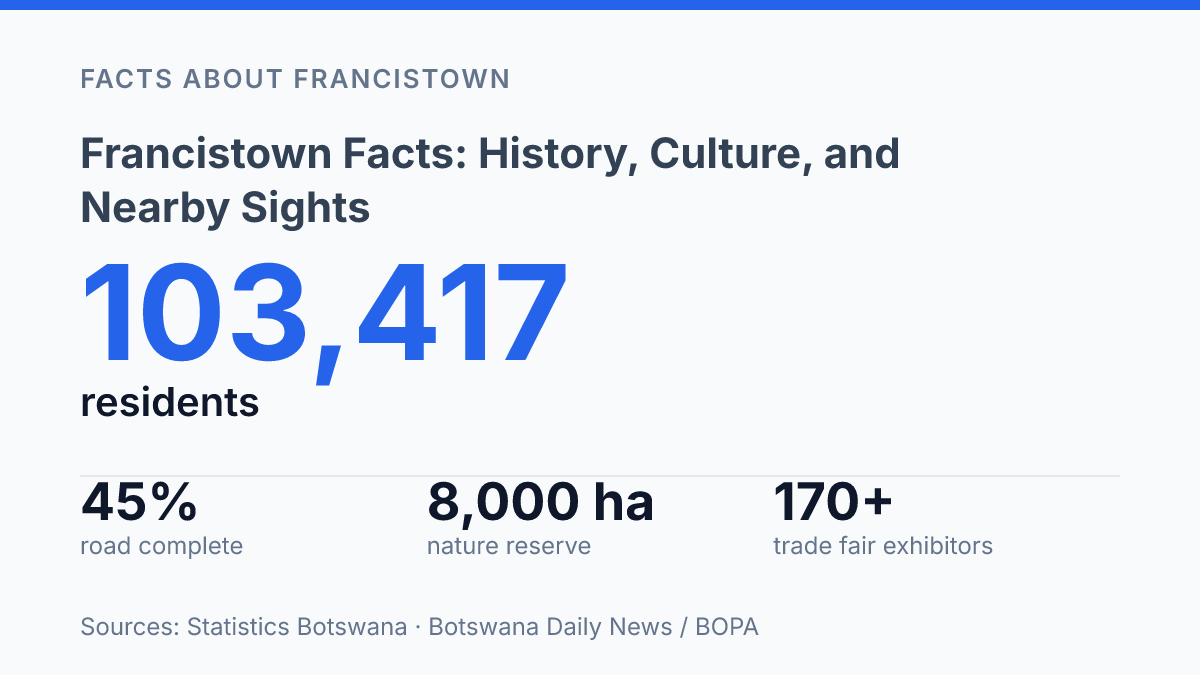
Francistown has 103,417 residents, but too many itineraries still treat Botswana’s northern city as a fuel stop on the way to somewhere else. That mistake costs you context. The city sits close to Ramokgwebana, a Botswana–Zimbabwe crossing open 06:00–22:00.
The 200-kilometre A3 route to Nata is being rebuilt under the weight of heavy truck traffic. This is not background noise. It explains why trade, road travel, and tourism all meet here.
The useful story starts with Supa Ngwao Museum, where Kalanga culture, early mining-era history, and craft work from roughly 200 makers give the city a face. Then the map widens.
Domboshaba reaches back to 1450 AD, Tachila offers wildlife near town. The city suits travelers who want Botswana without pretending every trip must revolve around the Okavango. In my honest opinion, that’s exactly why this place deserves a slower look.
Why Francistown sits at a key border crossroads
With 103,417 residents counted in 2022, including 49,647 males and 53,770 females, Francistown is too large to treat as a mere border stopover, according to Statistics Botswana.
Its position in eastern Botswana puts it close to the Zimbabwean border. That geography matters.
People, goods, and ideas have moved through this corridor for generations. The city has always looked outward as much as inward.
The city’s border role didn’t begin with modern highways. It grew from a 19th-century gold rush settlement, when prospectors and traders pushed into the area and turned a crossing point into a working town. Gold gave it its early spark, but movement gave it staying power.
Road and rail links still explain much of its character. Routes through the area connect Botswana’s capital, Gaborone, with Bulawayo in Zimbabwe, making the city a practical hinge between southern and western routes on one side and Zimbabwe on the other.
You don’t need to study a timetable to feel that. Trucks, buses, traders, and business travellers are part of the city’s everyday rhythm.
That gateway status comes with a tradeoff. The city is useful before it is polished.
It serves movement, commerce, errands, and overland plans. It doesn’t try hard to charm visitors at first glance. In my view, that’s exactly why it feels honest: the place reveals itself through function, not performance.
For travellers, this shapes expectations. Come looking for a glossy resort town and you’ll miss the point. Come looking for a border city with real history, cross-border energy.
A grounded urban pulse. The location starts to make sense fast.
What the Supa Ngwao Museum tells you about the city
A small museum can feel heavier than a monument when it holds the story of a town built on gold. The Supa Ngwao Museum chronicles Francistown’s history through the things people made, traded, used, and left behind. That matters here.
The city’s past isn’t abstract. It sits in tools, carvings, domestic objects, and mining-era memory.
The strongest thread is local identity. Exhibits on the Kalanga people give the collection its depth, especially when paired with traditional wood carvings, pottery, basketry, and musical instruments.
These aren’t decorative side notes. They show how culture survived alongside a mining economy that tried to define the town by extraction first.
Gold still casts the longest shadow. The museum ties the rush of the late 1800s to the settlement’s early shape, then lets you see what that boom missed: households, craft traditions, language, and community life. That contrast gives the place its edge.
A mining origin story can flatten a city into one commodity. The museum pushes back.
The museum is small. It carries the weight of a mining town’s origin story… and that contrast is exactly why it matters. Botswana Tourism says its craft shop supports approximately 200 craftspeople, mostly from surrounding areas, which turns preservation into present-day income rather than a locked display case.
In my honest opinion, this is the stop that makes the city feel specific instead of merely useful. You won’t need hours here. You do need attention.
The best parts are quiet. They reward anyone willing to look past the obvious gold-rush label.
Nature and ruins within easy reach of town
A short trip from the city can put you between an 8,000-hectare wildlife sanctuary and stone walls first built around 1450 AD. That range is the real surprise here.
The urban core can feel practical and workaday. The nearby outings pull the trip in two very different directions.
To the south, Tachila Nature Reserve gives you the animal-focused option without turning the day into a full national-park expedition. Daily News described it in 2026 as a wildlife sanctuary just outside town, with game drives, hiking trails, and birdwatching.
The reserve shelters animals such as hyenas and leopards. It has a wilder edge than its close-to-town position might suggest.
North of town, Domboshaba ruins offer a different kind of encounter. Botswana Tourism dates the site to 1450 AD and notes that it was among the first national monuments gazetted in 1938. Its stone walls and enclosures carry the force of age, especially because some walls reach up to two metres thick despite being built without cement.
These are not interchangeable stops. One asks you to watch the bush for movement. The other asks you to slow down and read stonework.
You can leave the center and reach either animals or ancient masonry. The choice says a lot about what kind of trip you want.
That’s the useful tension. Tachila suits travellers who want a nature break with a chance of wildlife, yet Domboshaba rewards patience more than adrenaline. In my humble opinion, the ruins are the stronger choice if you want the place to feel older than its roads, shops, and transit routes suggest.
Treat both as distinct day-trip style outings rather than casual add-ons between errands. The payoff is depth, not convenience alone: one side shows the living bush, the other preserves a built past that still holds its shape.
Who Francistown suits best
This is one of Botswana’s better stops for travelers who care more about mining scars and border movement than curated spectacle. It suits people who want a history stop tied to the country’s mining past, not a resort pause with rehearsed polish. You come for context, then the place asks you to look a little harder.
Visitors interested in Kalanga culture and nearby heritage sites will get more from it than visitors chasing a packed attractions list. The appeal is local and specific: memory, language, identity, and short excursions that still feel tied to the region around the city. In my view, that grounded scale is exactly why the culture feels credible.
It isn’t the kind of place that tries to impress you fast. That restraint makes the history and side trips feel more grounded.
That can disappoint travelers who want instant drama. It rewards those who like places with edges left visible.
The border setting also works in its favour. According to Botswana’s Department of Immigration and Citizenship, Ramokgwebana Border Post operates from 06:00 to 22:00 daily, a span that reflects steady overland movement through this corner of the country.
That practical rhythm gives the city a traveller’s edge. It feels connected without pretending to be polished.
The city is also being deliberately reframed, not reinvented. Daily News reported a city tourism initiative set for 24 January 2026.
The same report put Botswana tourism employment at close to 58,000 people. The push has money and jobs behind it.
The best fit is an overland traveler, a Botswana return visitor, or someone who prefers compact history to staged spectacle. If you need a major resort destination, you’ll underrate it. If you want a practical base with mining history, Kalanga culture, and nearby heritage stops, it makes strong sense.
Why timing matters more than most guides admit
Treat the next few years as a moving target, not a fixed guidebook entry. By 2026, the A3 rebuild was 45% complete. The Francistown City Tourism Initiative had made the city’s pitch more direct: stop passing through so quickly.
That doesn’t mean every traveler should build a whole holiday around it. Some will still use it for one night, a border run, or a business event.
The smarter move is to match your timing to your route. Check border hours, road works, museum opening times, and reserve access before you lock plans. In my humble opinion, the city rewards travelers who treat logistics as part of the experience, not the boring bit before the trip begins.
Frequently Asked Questions
Q: What is Francistown known for?
A: Francistown is known as a historic gold rush city in east Botswana, close to the Zimbabwean border. Its past matters because the mining era shaped the town fast. The cultural story didn’t stop there. The Supa Ngwao Museum keeps that history alive with exhibits on the local Kalanga people and traditional wood carvings.
Q: Is Francistown worth visiting?
A: Yes, if you want a city with history close to real wildlife and heritage sites. Francistown gives you a practical base for the Supa Ngwao Museum, Tachila Nature Reserve. The Domboshaba ruins. In my view, that’s a better mix than a lot of travelers expect.
Q: What can you see at the Supa Ngwao Museum?
A: The Supa Ngwao Museum shows Francistown’s gold rush history. It also goes deeper into local culture. You’ll find traditional wood carvings and cultural exhibits focused on the Kalanga people. That mix is what makes it useful, not just decorative.
Q: How far is Francistown from wildlife and nature reserves?
A: Tachila Nature Reserve sits south of Francistown and is one of the easiest nearby places for wildlife viewing. It shelters animals such as hyenas and leopards. You get a sharp contrast with the city’s mining past. That’s the surprise here… history in town, wildlife just outside it.
Q: What are the Domboshaba ruins near Francistown?
A: The Domboshaba ruins are a set of centuries-old stone walls and enclosures north of town. They give you a clear look at the region’s older settlement history, long before the gold rush era. Domboshaba is the key name to know, centuries-old tells you the age, and stone walls and enclosures is what you’ll actually see.