
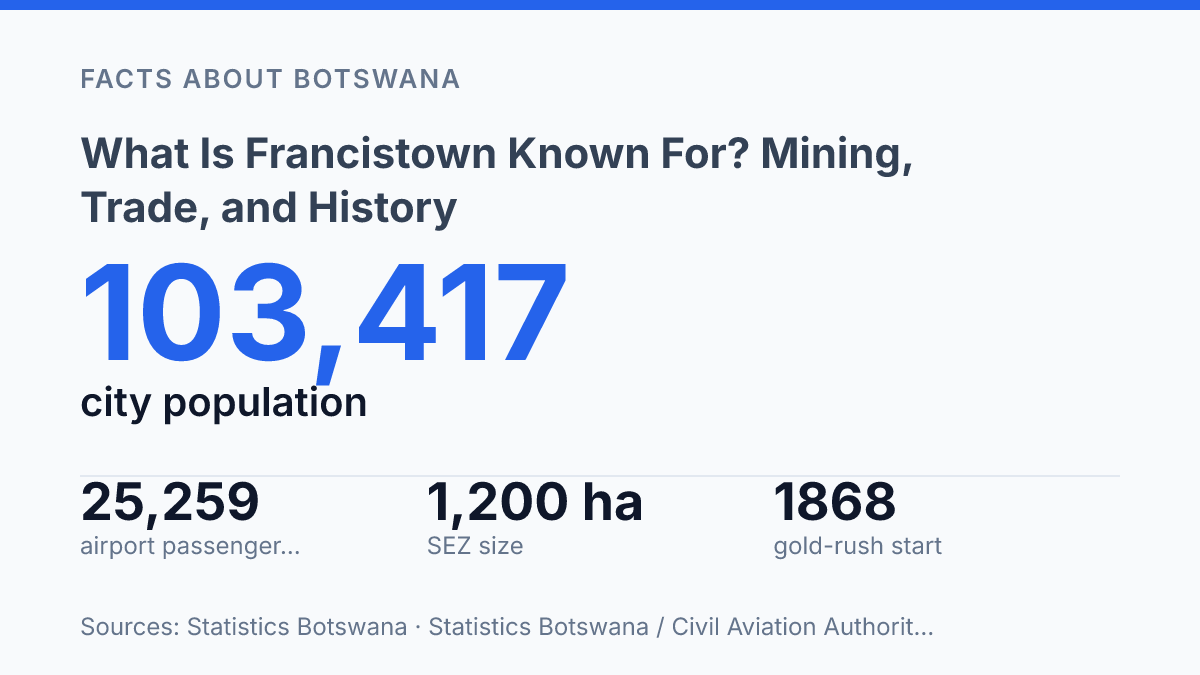
The question “What is Francistown known for?” has a measurable starting point: the city proper recorded 103,417 residents in Botswana’s 2022 Census, making it more than a relic of the old Tati goldfields. Francistown’s reputation rests on two connected roles. One is historical, shaped by Old Tati’s gold rush between 1868 and 1870, the arrival of the railway at Monarch in 1897, and early infrastructure such as Haskins Street.
The other is current, tied to transport, fuel supply, retail, services, and mining-linked logistics across northern Botswana. PG Matante Airport handled 25,259 passenger movements in 2024, while the planned 1,200-hectare Special Economic Zone positions the city as a Mining and Logistics Hub. The result is a city whose identity is not confined to heritage sites or commercial streets, but formed by the movement of minerals, goods, people, and capital across the north.
Why Francistown grew into Botswana’s northern hub
Francistown became Botswana’s northern hub because the same corridor that links Gaborone to Bulawayo also channels movement toward the country’s northern districts. The city sits near the Tati River in northeastern Botswana, close to the Zimbabwe border, placing it at a practical meeting point between domestic routes and cross-border movement. That geography helped make the settlement more than a local service town, as transport access gave it a wider regional function.
Its role is clearest in the alignment of road and rail connections. Francistown lies on the main route between Gaborone and Bulawayo, while also serving as a gateway toward northern Botswana. This position supports passenger travel, freight movement, public services, and commercial distribution, giving the city a logistical importance that extends beyond its municipal boundaries.
Scale reinforces that role. Francistown is widely recognised as Botswana’s second-largest urban centre, and according to Statistics Botswana’s 2025 report on the 2022 Population and Housing Census, its city-proper population was 103,417, with 53,770 females and 49,647 males; Monarch East had 6,213 people and Area Donga had 4,960. These figures frame Francistown as a major northern urban centre rather than simply a historic mining settlement.
The same strategic location that makes Francistown visible as a transport and services centre can also obscure the older economic forces that first drew sustained attention to the area. Its modern identity rests on accumulated advantages: a river-adjacent setting, proximity to Zimbabwe, connection to the national road and rail network, and enough urban scale to anchor services for surrounding districts. That combination explains why the city is commonly associated with transit, trade, administration, and northern Botswana’s wider economy.
The gold rush that shaped the city
Old Tati is often described as Southern Africa’s first gold-rush site, with about 250 prospectors and miners active there between 1868 and 1870, according to DailyNews/BOPA. That early rush gave the wider Tati Goldfields a prominence that predated many later mineral booms in the region. The discoveries drew prospectors, trading interests, and colonial-era speculation into an area that became closely associated with mineral wealth long before Botswana’s modern mining economy took shape.
The city’s name preserves that early mining connection through Daniel Francis, the British prospector and entrepreneur linked to the Tati concessions. The City of Francistown Council records that Francis acquired prospecting licences in 1869, tying his name directly to the goldfields that influenced the settlement’s early development. His association with the area did not simply provide a name; it helped anchor the city’s public memory in the era when claims, concessions, and mining finance shaped settlement patterns.
Large-scale gold mining later declined as the richest accessible deposits lost their early momentum and economic activity diversified. This shift matters because the city is still remembered through its gold-rush origins, but its modern role cannot be reduced to gold output. Mining history supplies the origin story and much of the heritage language around the city, while present-day identity rests more on administration, transport functions, and commercial activity than on active gold production.
That contrast explains why the gold rush remains central to the city’s reputation without defining its whole economy. The Tati Goldfields made the settlement famous and gave it a durable historical brand, yet the decline of major gold extraction pushed the urban centre toward broader regional functions. In this sense, gold shaped the memory of the place more permanently than it shaped its current economic base.
Trade, retail, and services in the north
Nzano Mall’s full occupancy in Turnstar Holdings’ 2024 annual report gives a concrete measure of Francistown’s retail pull rather than just its reputation as a commercial stop. The property was reported at 12,654.78 m² of gross lettable area, valued at BWP 190,000,000, with 100% tenant occupancy, indicating sustained demand for formal shopping space. That demand is supported by households from the city and by consumers from smaller settlements that depend on Francistown for higher-order retail, banking, and service needs.
The city’s commercial role also rests on movement: goods, passengers, fuel, and routine services pass through Francistown as part of northern Botswana’s wider supply system. PG Matante Airport handled 25,259 passenger movements in 2024, including 12,996 arrivals and 12,263 departures, according to Statistics Botswana and the Civil Aviation Authority Botswana; the year-on-year increase of 13.8% points to the continuing relevance of air access alongside road freight and passenger transport. Logistics investment reinforces the same pattern, with the Special Economic Zones Authority describing Francistown’s planned 1,200-hectare Special Economic Zone as a mixed-use logistics hub intended to include the country’s largest inland dry port.
Cross-border commerce with Zimbabwe adds another layer to this function, especially for traders, transporters, and service providers whose activity depends on regional movement rather than only local demand. This creates opportunity for warehousing, fuel supply, vehicle services, and retail turnover, but it also means commercial rhythms can shift when border procedures, currency conditions, import rules, or wider economic trends change. Francistown’s strength is therefore not a fixed advantage; it is partly maintained by how well the city absorbs and redirects regional traffic.
Public services deepen that commercial base by drawing people into the city for reasons beyond shopping. Government offices, schools, and health facilities give Francistown an administrative and social-service role for surrounding districts, supporting travel into the city for paperwork, education, treatment, and related spending. Botswana Oil’s 2024/2025 procurement plan, which includes a P200,000,000 Francistown Expansion Project and a P50,000,000 truck-staging project, also shows how public and strategic infrastructure decisions continue to strengthen the city’s role in northern supply networks.
Local landmarks and cultural identity
Francistown’s public memory is unusually layered: a museum, a first tarred street, and railway-era remains carry a history that is easier to miss than the city’s more visible roads and shops. Supa Ngwao Museum is central to that identity because it preserves local historical material rather than treating the city only as a point on a map. Its collections and educational role help connect the Tati-area past with the communities that later formed the modern city, giving residents and researchers a fixed institution through which local memory can be interpreted.
The older built environment also gives Francistown a recognisable historical texture. The City of Francistown Council records that the railway reached Monarch on 1 September 1897, a date that links the city’s physical development to the railway and the late-19th-century mining frontier. Haskins Street is also identified by the council as Botswana’s first tarred road, which makes it more than an ordinary urban street: it is a marker of early infrastructure in a settlement shaped by prospecting, transport, and administration.
Much of this heritage is not monumental in the way that a single preserved fort or palace might be. It is distributed across street names, old alignments, railway associations, civic memory, and surviving references to the pioneer mining period.
That makes Francistown’s historical identity strong but sometimes less immediately visible than its modern traffic corridors and commercial buildings. The result is a city whose past often has to be read through institutions, local records, and modest urban traces rather than through one dominant landmark.
The city’s wider public image is also shaped by nearby nature sites, especially Tachila Nature Reserve. Its presence broadens Francistown’s identity beyond mining history and urban services by associating the area with conservation, environmental education, and access to wildlife close to the city. In cultural terms, that matters because it places Francistown within both a human history of settlement and an ecological setting that remains part of how the city is understood.
Where the northern corridor points next
Francistown’s next chapter will depend less on nostalgia for the gold rush than on whether its transport and logistics role translates into durable urban value. A planned inland dry port, fuel infrastructure investment, and mining-linked industrial demand could strengthen the city’s position, but those gains are not automatic. They require coordinated land use, reliable services, and commercial activity that benefits more than freight operators and property owners.
The useful lens is continuity: Francistown began as a place where mineral discovery, routes, and settlement converged, and the same forces still define its prospects. If the northern corridor keeps gaining strategic weight, Francistown’s importance will be measured not only by what passes through it, but by what remains and grows there.
Frequently Asked Questions
Q: Why is Francistown historically important?
A: Francistown is one of Botswana’s oldest urban centres and developed around the gold rush in the late 19th century. That origin shaped its early growth and explains why mining remains central to its identity.
Q: Is Francistown still a mining town today?
A: Mining remains part of Francistown’s economy, although the city is no longer defined only by gold. Its role has broadened as commerce, services, and transport have become more significant.
Q: What makes Francistown a trade hub?
A: Francistown sits on key transport routes linking Botswana with Zimbabwe and northern parts of the country. That location supports cross-border trade, distribution, and business activity serving a wide regional catchment.
Q: Are there historical places to visit in Francistown?
A: The city has several sites connected to its mining and colonial past, including heritage buildings and older neighbourhoods. These places help show how the city developed from a mining settlement into a regional centre.
Q: How does Francistown compare with Gaborone?
A: Gaborone is the national capital, while Francistown has traditionally been known more for mining and trade in the north. The two cities serve different economic functions, which makes Francistown important as a regional commercial and transport centre.